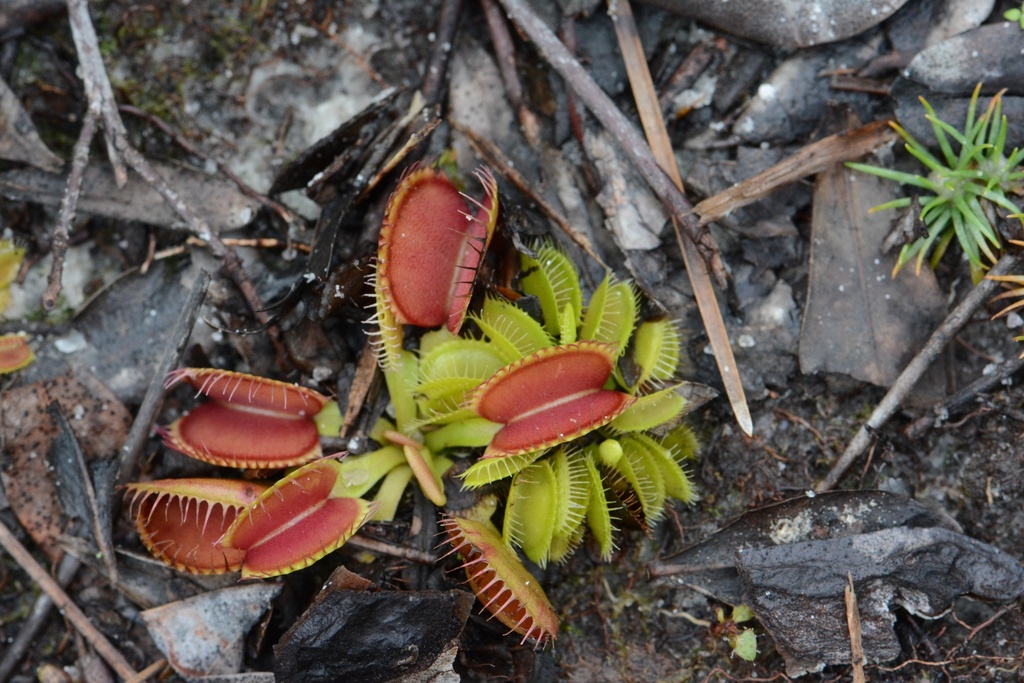
What is a Venus flytrap?
The Venus flytrap (Dionaea muscipula) is the world’s most recognizable carnivorous plant, native to the nutrient-poor, boggy longleaf-pine savannas of North and South Carolina. It compensates for its infertile habitat by catching and digesting insects and spiders in hinged snap-trap leaves lined with sensitive trigger hairs. When prey brushes two hairs within about 20 seconds, the lobes slam shut in under half a second — one of the fastest movements in the plant kingdom. Indoors it thrives under bright light with distilled water and a proper winter dormancy.
How much light does a Venus flytrap need?
Venus flytraps demand full, direct sun — at least 4–6 hours per day. A south-facing windowsill is the minimum for healthy trap production; a dedicated grow light (full-spectrum, 12–16 hours a day) can fill the gap in darker homes. Without adequate light the traps become elongated and pale, lose their red interior coloration, and rarely close on prey. This is the single most common reason indoor flytraps fail.
How do you water a Venus flytrap?
Water is where flytraps catch most growers off guard. They must have only distilled water, rainwater, or reverse-osmosis water — tap water, filtered tap, and any fertilized water will kill the plant over time by introducing minerals to roots adapted to near-zero nutrient levels. The easiest method is the tray method: set the pot in a saucer with 1–2 cm of distilled water at all times during spring and summer. In winter dormancy, keep the medium just barely moist — not waterlogged.
Why is my Venus flytrap not catching anything?
Traps that stay limp, stay open, or fail to trigger are almost always caused by insufficient light or mineral damage from tap water. Individual traps also have a natural lifespan of roughly three to five closures before they die back — a spent black trap is normal and can be pruned at its base. Never repeatedly trigger traps with a finger; each closure costs the plant energy, and wasted closures shorten trap life without any nutritional benefit.
Does a Venus flytrap need to go dormant?
Yes — dormancy is non-negotiable for long-term survival. Without a winter rest of 3–5 months at 35–50°F (2–10°C), flytraps deplete their energy reserves and die within two to three years. In nature this rest is triggered by shorter days and cooler temperatures from November through February. Indoors, move the plant to an unheated garage, cool basement, or even a refrigerator (in a ventilated bag). Let old leaves die back, reduce watering to barely moist, and bring it back to warmth and light in early spring.
Is a Venus flytrap safe for pets?
Yes. The ASPCA lists Venus flytrap as non-toxic to cats, dogs, and horses, making it one of the more pet-friendly unusual houseplants. The trapping mechanism is harmless to animals much larger than an insect — a curious paw or nose will trigger a trap, but the plant cannot cause injury or toxicity.